


 |
Molino de bolas de laboratorio de 6L de capacidad con velocidad de rotación de 70-670 rpm y bajo ruido (< 60db) para molienda seca y húmeda
Datos del producto:
| Lugar de origen: | Hunan, China |
| Nombre de la marca: | TENCAN |
| Certificación: | CE ISO |
| Número de modelo: | WXQM-6 |
Pago y Envío Términos:
| Cantidad de orden mínima: | 1 juego |
|---|---|
| Precio: | Negociable |
| Detalles de empaquetado: | cartón+espuma |
| Tiempo de entrega: | 15-20 días laborables |
| Condiciones de pago: | T/T, Unión Occidental |
| Capacidad de la fuente: | 200 juegos por mes |
|
Información detallada |
|||
| Volumen total: | 6l | Capacidad máxima: | 1.98L |
|---|---|---|---|
| Voltaje: | 220V-50Hz | Fuerza: | 0.75 |
| Velocidad de rotación: | 70-670 rpm | Ruido: | Menos de 60dB |
Descripción de producto
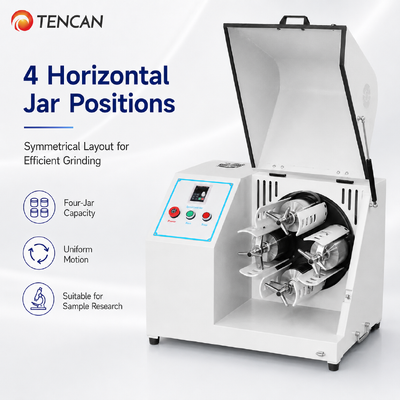
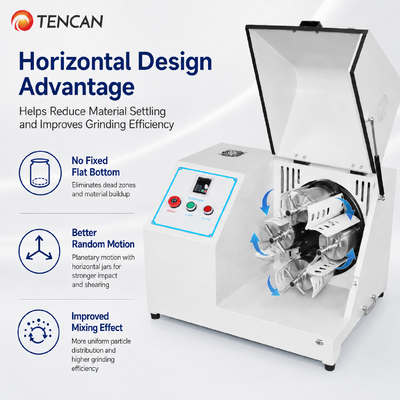
Un molino de bolas planetario horizontal compacto diseñado para la molienda fina de laboratorio, mezcla de polvo, preparación de muestras y investigación de lotes pequeños.La estructura horizontal del frasco ayuda a mejorar el movimiento del material y reducir el hundimiento del material durante el fresado.

El molino de bolas planetarias horizontales de laboratorio se utiliza para el molienda de materiales de alta tecnología, molienda fina, mezcla de polvo, preparación de nano polvo, desarrollo de nuevos productos y producción en pequeños lotes.Con estructura compacta, alta eficiencia, bajo ruido y funciones completas, es adecuado para instituciones de I + D, universidades, laboratorios empresariales y centros de prueba de materiales.
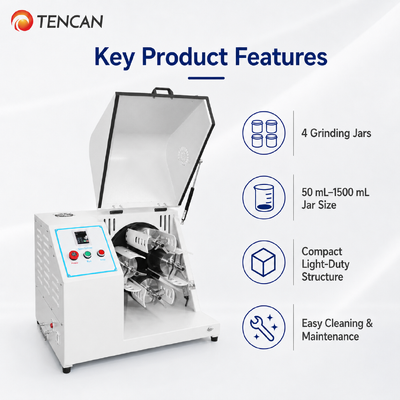
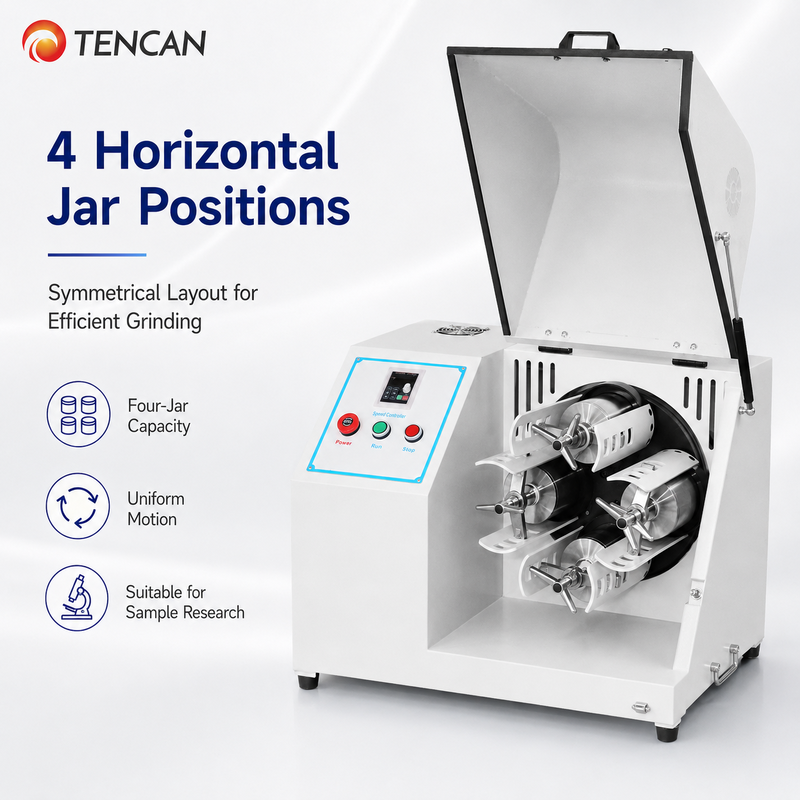
La máquina está diseñada con cuatro posiciones de trabajo, lo que permite que dos o cuatro tarros de molienda trabajen juntos.Cuando estén equipados con frascos de molino de vacío, también puede utilizarse para el procesamiento de polvo en condiciones de vacío o de atmósfera protectora.
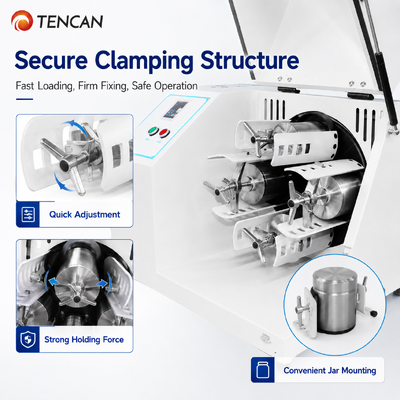
Cuatro tarros de moler están instalados horizontalmente en una plataforma giratoria. Cuando la plataforma giratoria gira, cada tarro realiza movimientos planetarios.Las bolas de molienda y los materiales dentro de los frascos son impactados continuamente, cortado y mezclado a alta velocidad, por lo que los materiales se muelen gradualmente en polvo fino.
La disposición horizontal del frasco ayuda a reducir el material que se pega a la pared del frasco y se hunde en el fondo,que lo hace más adecuado para materiales que requieren una mejor dispersión y una molienda más uniformeLa molienda en seco y la molienda en húmedo están disponibles, y la granularidad de salida más pequeña puede alcanzar 0,1 μm en condiciones de proceso adecuadas.
- Estructura del frasco horizontal:ayuda a reducir la sedimentación del material y mejora la uniformidad de molienda.
- Sistema de transmisión de engranajes:proporciona una transmisión estable y resultados experimentales repetibles.
- Operación de cuatro frascos:soporta la molienda de varias muestras con diferentes materiales o tamaños a la vez.
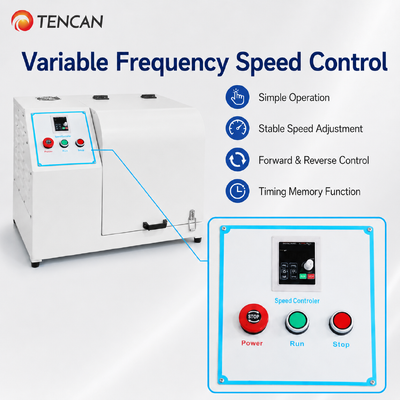
- Control de frecuencia variable:Los usuarios pueden seleccionar una velocidad de rotación adecuada de acuerdo con las características del material y la precisión de la meta.
- Función hacia adelante y hacia atrás:Se pueden seleccionar modos de sincronización, alternativos y continuos para mejorar la eficiencia de molienda.
- Funcionamiento seguro:el interruptor de seguridad ayuda a evitar que la máquina funcione cuando la tapa está abierta.
- Diseño de bajo ruido:adecuado para entornos de laboratorio donde se requiere un funcionamiento estable y silencioso.
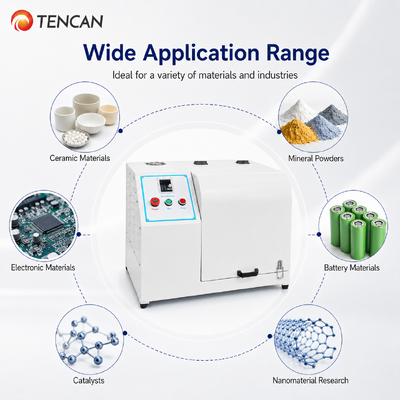
Este molino de bolas planetario horizontal de laboratorio es ampliamente utilizado en geología, minería, metalurgia, electrónica, materiales de construcción, cerámica, industria química, industria ligera, medicina,protección del medio ambiente, y la investigación de nuevos materiales.
Los materiales típicos incluyen cerámica electrónica, cerámica estructural, materiales magnéticos, materiales de baterías, catalizadores, fósforos, polvos de pulido de tierras raras, vidrio electrónico en polvo,Materiales para pilas de combustible, varistores de óxido de zinc, cerámicas piezoeléctricas, nanomateriales, materiales MLCC, cerámicas dieléctricas, cerámicas de alúmina, cerámicas de zirconia, ferrita Ni-Zn, ferrita Mn-Zn,y otros materiales avanzados en polvo.
| Modo de accionamiento | Accionamiento de engranajes |
| Modo de funcionamiento | Dos o cuatro tanques de molienda trabajando juntos |
| Capacidad máxima de carga | 2/3 de la capacidad del tanque de fresado |
| Tamaño de alimentación | Material del suelo ≤10 mm, otros materiales ≤3 mm |
| Granularidad de la salida | El grano más pequeño alcanza los 0,1 μm |
| Relación de velocidad de rotación | 1/2 |
| Tiempo de funcionamiento continuo | 72 horas |
| Modos opcionales de control de velocidad | Conversor de frecuencia y control automático del tiempo |
| Materiales del frasco | Acero inoxidable, ágata, nylon, corindón, zirconía, etc. |
| Número de modelo. | Potencia (kw) | Ventilación (v) | Dimensión (mm) | Velocidad de rotación (rpm) | Velocidad de rotación (rpm) |
|---|---|---|---|---|---|
| ¿Qué es esto?4 | 0.75 | 220 V-50 Hz | 700*510*570 | 35 a 335 | 70 a 670 |
| Se trata de un sistema de control de las emisiones. | 0.75 | 220 V-50 Hz | 700*510*570 | 35 a 335 | 70 a 670 |
| Se trata de un sistema de control de las emisiones de gases de escape. | 0.75 | 220 V-50 Hz | 700*510*570 | 35 a 335 | 70 a 670 |
| Se trata de un sistema de control de las emisiones. | 0.75 | 220 V-50 Hz | 700*510*570 | 35 a 335 | 70 a 670 |
| Se trata de un sistema de control de las emisiones. | 0.75 | 220 V-50 Hz | 700*510*570 | 35 a 335 | 70 a 670 |
Envases de molino disponibles:Jarrón de molino de acero inoxidable 304, jarro de molino de acero inoxidable 316, jarro de molino de carburo de tungsteno, jarro de molino de ágata, jarro de molino de alumina cerámica (también llamado jarro de molino de corindón), jarro de molino de zirconio, jarro de molino de nylon,Jarrón de molino de poliuretano, frascos de molino (PTFE), etc.
Las bolas de molino disponibles:Es decir, el valor de las importaciones procedentes de la República Federal de Alemania, de la República Federal de Alemania, de la República Federal de Alemania, de la República Federal de Alemania, de la República Federal de Alemania, de la República Federal de Alemania, de la República Federal de Alemania, de la República Federal de Alemania, de la República Federal de Alemania, de la República Federal de Alemania, de la República Federal de Alemania, de la República Federal de Alemania, de la República Federal de Alemania, de la República Federal de Alemania, de la República Federal de Alemania, de la República Federal de Alemania, de la República Federal de Alemania, de la República Federal de Alemania, de la República Federal de Alemania, de la República Federal de Alemania, de la República Federal de Alemania, de la República Federal de Alemania, de la República Federal de Alemania, de la República Federal de Alemania, de la República Federal de Alemania, de la República Federal de Alemania, de la República Federal de Alemania, de la República Federal de Alemania, de la República Federal de Alemania, de la República Federal de Alemania, de la República Federal de Alemania, de la República Federal de Alemania, de la República Federal de Alemania, de la República Federal de Alemania, de la República Federal de Alemania,
Para diferentes tipos de muestras, finalidad objetivo, capacidad del lote y requisitos de control de contaminación, TENCAN puede proporcionar recomendaciones adecuadas de tarros de molino y medios de molienda.Los usuarios pueden seleccionar el acero inoxidable, zirconia, ágata, nylon, corindón, PTFE, poliuretano u otros materiales para frascos según los requisitos de pureza, dureza, resistencia al desgaste y compatibilidad química.